

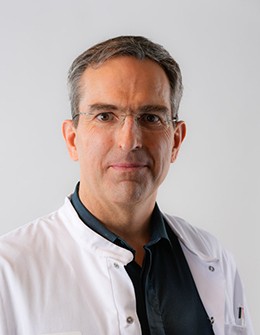
 “Current treatments for Parkinson’s disease treat the symptoms, for example by trying to increase dopamine levels in the brain, but they do not act on either the cause of the disease or its progression. Here, even if we may not be acting directly on the cause, we hope to influence the progression of the disease by slowing the gradual advance of damage in the brain.” — Prof. Gaëtan Garraux
Prof. Gaëtan Garraux is a clinical neurologist at CHU de Liège, where he heads the MoVeRe clinic, dedicated to Parkinson’s disease and movement disorders. He is also Professor of Physiology of the Nervous System at the University of Liège (ULiège) and a researcher at GIGA, the interdisciplinary biomedical research centre of the University of Liège, where he continues his work on Parkinson’s disease. In 2026, the Demoucelle Parkinson Charity provided seed funding for the research project described below:
—————
In Parkinson’s disease, brain cells, including those that produce dopamine, gradually die, but the exact cause of this loss remains unknown. One of the avenues being investigated by Prof. Gaëtan Garraux and his team is a disruption of the immune system, the network of cells in our body that normally protects us against attacks from, for example, viruses, bacteria or other diseases. In some cases, this system appears to become dysregulated and, instead of protecting the brain, may contribute to damaging it.
At the heart of this research is the role of neutrophils, a type of white blood cell that acts on the front line, rather like firefighters called to a fire: they respond very quickly to defend the body against threats and, once the situation is under control, make way for others. Without adequate brakes, these “firefighters” remain abnormally active and continue releasing their substances long after the “fire” has been put out, damaging healthy tissue around them and preventing the next stages of the response from taking place.
These brakes occur naturally in our bodies, but their action may be insufficient in Parkinson’s disease. There are medicines that mimic these brakes and are already approved for the treatment of certain rare diseases. Prof. Garraux’s hypothesis is that using one of these medicines in Parkinson’s disease could help better regulate the activity of these neutrophils and thereby slow the progression of the disease.
Before this hypothesis can be tested in a sufficiently large number of participants, Prof. Garraux’s team is launching a Phase 1 pilot study involving 12 people with Parkinson’s disease, in order to confirm safety and tolerability as has previously been observed in other diseases in which this medicine has been used.
Inflammation and the immune system: what is the link with Parkinson’s disease?
 “It is true that one of the best-known characteristics of the disease is a reduction in dopamine in the brain. Everyone knows that. But we do not know exactly what causes this reduction. Dopamine is produced by neurons, and some of these neurons are particularly vulnerable to a process that has not yet been identified and that causes them to die gradually.
There are several hypotheses to explain why these neurons die, and one of them involves a localised dysregulation of the immune system. This is not a new idea: the role of the immune system in Parkinson’s disease, but also in other degenerative diseases such as Alzheimer’s disease, has been studied for more than 40 years.”
“The immune system is at least as complicated as the nervous system, and there are many different ways of approaching how it works. Normally, this system protects us against all kinds of threats, for example from viruses or bacteria, including through the controlled release of substances that destroy pathogens. But in Parkinson’s disease, it is possible that it no longer does this appropriately. Some research even suggests that this system, which is supposed to respond in a coordinated way to the threat posed by the disease, may itself be disrupted and that, instead of protecting us, it may worsen the disease.”
Why focus specifically on neutrophils?
Several abnormalities of the immune system have been observed in people with Parkinson’s disease, but we do not know the sequence in which they occur.
“Among these, one robust observation, reproduced in several studies, is a slight increase in the proportion of neutrophils compared with other white blood cells in the blood, even in the early stages of the disease. We also see an indirect link between the proportion of neutrophils and the speed of disease progression, regardless of the patients’ profile. This suggests that these first-line white blood cells may have an abnormally prolonged effect on brain function.”
Does this mechanism affect all patients, or only some?
“This could represent a fairly general mechanism that acts early in the cascade of events leading to the progressive destruction of certain areas of the brain. Neutrophils are, after all, our first line of defence against a threat. They therefore act very early. We can imagine that they may also become involved very early in the neurodegenerative process, which raises the hope that acting on them could have a fairly broad effect. But at this stage, this remains a hypothesis.”
How can the balance of the immune system be restored?
One way of counteracting excessive, abnormal neutrophil activity is to use “molecular brakes”. Prof. Garraux’s project proposes using one of these brakes, which occurs naturally in the body but whose action may be insufficient to counter the excessive activity of neutrophils: alpha-1-antitrypsin.
“What makes this molecular brake interesting is that it does not act only on neutrophils: it intervenes at several stages of the inflammatory cascade, which could help regulate the immune system as a whole, rather than just one type of cell. In addition, this compound has already been used for many years to treat people with a rare disease characterised by insufficient production of this molecular brake.”
We are talking about a “disease-modifying” treatment: what does that mean?
“That is really the central idea behind this project. Current treatments for Parkinson’s disease treat the symptoms, for example by trying to increase dopamine levels in the brain, but they do not act on either the cause of the disease or its progression. Here, even if we may not be acting directly on the cause, we hope to influence the progression of the disease by slowing the gradual advance of damage in the brain.
This does not rule out the possibility that this immune mechanism may also be at the origin of the disease, but we do not yet have enough evidence to say so. In any case, according to the various studies, it certainly contributes to the progression of the disease. And if everything goes as hoped, we may be able to intervene very early, very far upstream in this cascade of events.”
You are now going to test this approach in patients: a Phase 1 study involving twelve people. What does this involve, and why this number?
“Because this product has never previously been used in people with Parkinson’s disease, we first need to evaluate its tolerability and potential side effects in this specific context. This medicine is already approved for treating certain rare diseases, where it is generally well tolerated, with very few patients discontinuing treatment. So, in theory, it has a good safety profile, but we can never be certain of this before testing it in a new population, in this case people with Parkinson’s disease.
This initial safety assessment is generally carried out in a small number of carefully selected people, with a medical profile that limits the risk of side effects, although this risk can never be completely excluded. This will provide us with information about the safety of using this product in this population.
Another factor limiting the number of patients is cost, since the product is currently extracted from human plasma, making it expensive to produce in large quantities.”
Since this product already exists as a medicine for another disease, could this speed things up?
“Yes, that is precisely the advantage of using a product that already exists as a medicine: the entire development process and previous studies have already been completed, allowing for a real acceleration. For a completely new molecule, it generally takes between 5 and 10 years before it can be tested and then reach the market.
For the time being, this product is approved only in a very specific medical context. It is not yet a medicine for Parkinson’s disease: that is precisely what this Phase 1 study is intended to begin evaluating.”
What will be measured during this study, and how?
In addition to assessing its safety, “this Phase 1 study will provide preliminary information about its potential beneficial effects. To do this, we will use several types of measurements.
First, a blood test: since we are acting on the immune system, we want to see whether there is a measurable effect on it, even if ultimately there is not yet any visible effect on the disease itself.
Next, the progression of the disease can be assessed in several ways. First, through a thorough clinical examination of mobility during consultations. A more sensitive method is to use motion sensors, for example a smartwatch worn continuously, which provides information continuously rather than only during visits spaced several months apart. This allows us to assess the progression of the disease continuously, more precisely and quantitatively, during the study and probably also for several months after treatment has stopped.
Finally, we can directly measure indicators of neuronal loss in the brain. Nuclear medicine techniques such as PET scans are highly sensitive but expensive and invasive, because they expose patients to radiation. For around a decade, more sophisticated MRI techniques have made it possible to obtain similar information non-invasively.”
To conclude: what message would you like to give patients?
 “Alongside the medical and scientific aspects, there is a whole social and family dimension, as well as a personal investment, that are often overlooked in the management of this disease. Family and social support matter, but so does being able to accept the disease oneself and adapt one’s lifestyle to one’s abilities. We know, for example, that physical activity is very beneficial, but it can only be undertaken by the individual themselves: being well supported and motivated enables everyone to take action that can influence the progression of their own disease.
In Belgium, medical care is of a very high standard, but patient support could be improved. Resources are not always sufficient or well structured. I think organisations such as yours have an important role to play in changing the way the disease is managed, beyond the medical sphere alone.”
“It is not enough to have a single centre where very good things are being done if thousands of patients are left behind, unable to benefit from them.” — Prof. Gaëtan Garraux