
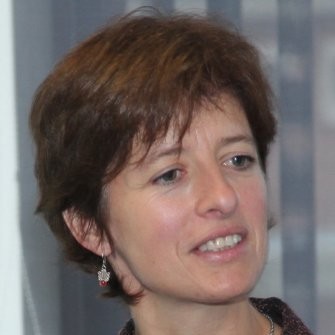

“If we can prevent alpha-synuclein from clumping together in the brain, we believe we could slow the progression of Parkinson’s disease, or even prevent some of it by intervening early enough.” — Prof. Veerle Baekelandt, KU Leuven
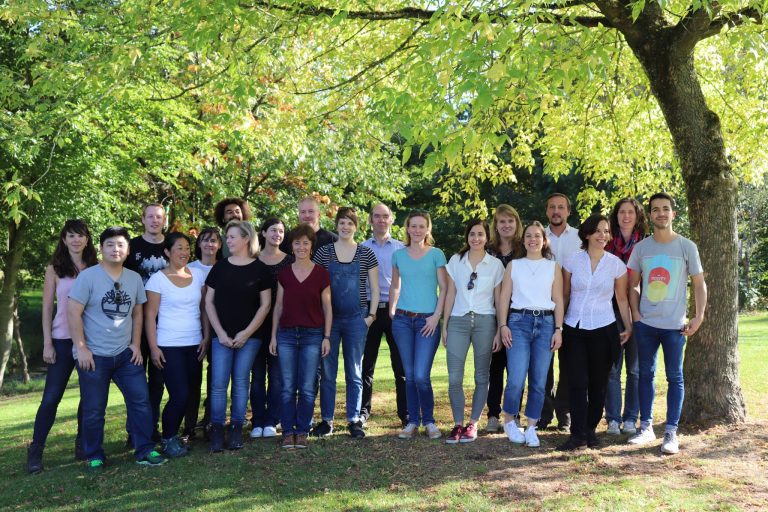
Prof. Veerle Baekelandt is a professor at KU Leuven and heads the Laboratory for Neurobiology and Gene Therapy, which is part of the Department of Neurosciences within the Faculty of Medicine. Her research group studies the molecular causes of Parkinson’s disease. The Demoucelle Parkinson Charity provided seed funding in 2026 for research to find a molecule that can prevent alpha-synuclein from clumping together.
Think of the protein in a raw egg: it is liquid and dissolves easily. Cook it, and it coagulates and becomes insoluble, and that change cannot be reversed. According to researcher Veerle Baekelandt, something similar happens with alpha-synuclein, a protein naturally found in everyone’s brain. In Parkinson’s disease, this protein starts to clump together forming aggregates that no longer dissolve. This process may contribute to the development of the disease.
Baekelandt and her team have developed a way to reproduce this aggregation process using human brain cells grown in the laboratory with the aim of finding which substances can slow it down. The current challenge is to make the ‘test’ system as accurate a reflection as possible of what actually happens in patients’ brains, so that a substance that works well under laboratory conditions has a realistic chance of continuing to work in more complex models and, ultimately, in patients.”
How did you get into Parkinson’s research?
“It was really a series of coincidences. I studied biology and quickly became fascinated by the brain. During my PhD, I studied the normal functioning of the adult brain, but I increasingly felt the need to do something that was more relevant to patients. I then did a postdoctoral fellowship on Alzheimer’s disease, and it was during that period that the first mutations in alpha-synuclein, linked to a genetic form of Parkinson’s disease, were discovered. At the time, almost nothing was known about it. A few researchers at KU Leuven wanted to start working on the subject, and at that point no one in Leuven was really doing fundamental research into Parkinson’s disease. It turned out to be both very interesting and a real opportunity: there was still so much to discover.”
What exactly is alpha-synuclein, and why is it so important in Parkinson’s disease?
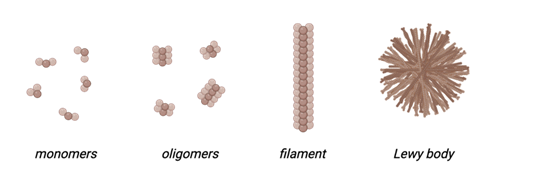 “As in the egg example I mentioned earlier, alpha-synuclein normally functions perfectly well. It is actually one of the most abundant proteins in our brains. But in Parkinson’s disease, we see that it starts to clump together and accumulate.
The question is: how important actually is this accumulation, because the (Parkinson’s disease) symptoms are more directly caused by the death of brain cells that produce dopamine. The most widely-accepted theory is that the accumulation of alpha-synuclein contributes to the death of these brain cells and therefore occurs at the beginning of the disease process that eventually leads to the symptoms. However, this has not yet been confirmed and there are still many hypotheses. However, we do believe it is a very important player and probably plays a role very early on in the disease process.
Why does a normal-functioning protein suddenly start to accumulate abnormally? That is a question that could hopefully also provide new clues about how the disease actually develops.”
What exactly does screening candidate molecules involve, and what makes your approach different?
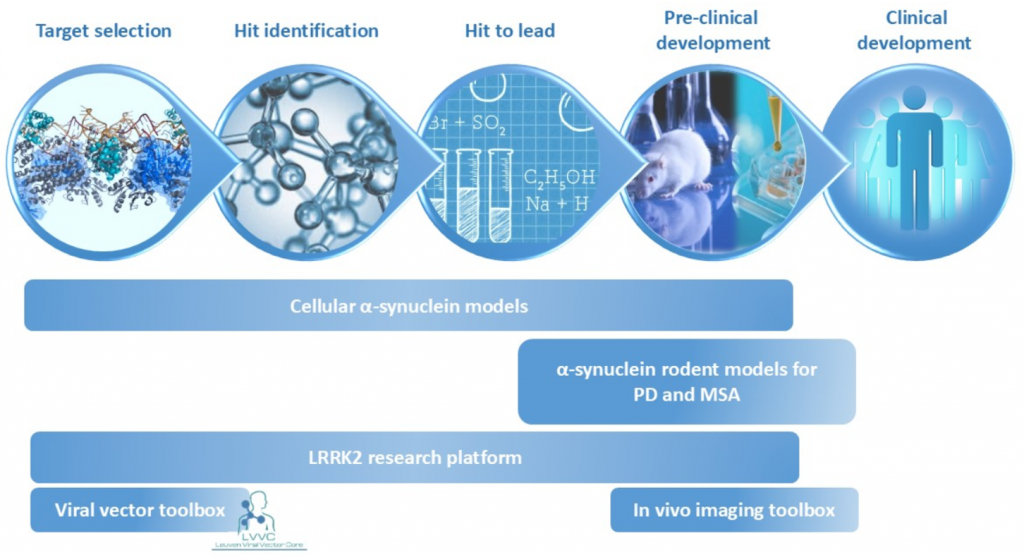
“Our research focuses on the accumulation of alpha-synuclein. We are looking for molecules that can prevent it, counteract it or even reverse it. To find them, we carry out drug screening. This means testing a large number of substances one after another to see whether they produce a particular effect. In our case, can they prevent alpha-synuclein from accumulating? We are therefore targeting something different from existing treatments, which mainly aim to increase dopamine. We are intervening directly in the accumulation of alpha-synuclein itself. For this, we need a testing system: cells in which we can induce the accumulation of alpha-synuclein and monitor it precisely, so that we can reliably determine whether a substance can prevent it.
We use cell lines: cells that were originally derived, usually, from a tumour and that can easily be multiplied and modified in the laboratory. They are convenient to work with while still having enough characteristics that resemble those of brain cells. Cells taken directly from people are much more difficult to use for screening on this scale, both technically and ethically.
We have modified these cells so that alpha-synuclein actually starts to accumulate in them, using an automated system that we can monitor closely. On a test plate with a large number of individual wells containing the same cells, we add a different substance to each well and then look at which substances can prevent the accumulation.
We also use this screening system to try to reproduce as closely as possible what happens in the brains of patients, so that the substances we identify have a greater chance of actually working in patients.
This brings me to an important nuance: a positive result in a cell model like this, or even later in an animal model, does not guarantee that a substance will work in humans. It remains a simplified representation of what happens in a real human brain, and that is precisely why a good result in the laboratory does not always lead to the same result in patients.
It is precisely to reduce this risk as much as possible that we spent years developing the testing system itself before we began screening. The more closely it reflects what we know about patients’ brains, the greater the chance that a substance that produces a positive result will continue to do so at later stages, in organoids, in animals and ultimately in humans.”
What are the next steps?
“A substance that emerges from our screening is not yet a medicine. It is a first lead, a kind of starting point. Together with chemists, we then work on improving the substance in many ways, for example its ability to be properly absorbed by the brain.
We then test the most promising candidates in more complex systems: organoids, which are essentially small brains grown in a laboratory and already have a more developed three-dimensional structure, and in mice, which have fully functioning brains.
Depending on the results, the molecules sometimes need to be modified again. But if things go well, we can eventually move towards a first clinical study. That is not going to happen immediately, but that is precisely the purpose of these different stages: to arrive at a molecule that can ultimately be tested in humans.”
What role has philanthropy played in your career?
“Research costs money: salaries, equipment and operating costs. In addition to public funding and industry partners, philanthropy is an important additional source of funding. It gives us a little more freedom to respond quickly to new findings, which is important in a field of research where progress is often unpredictable by nature.
For me personally, there is something else as well: when I know that this money comes from individuals who have consciously chosen to support this particular Parkinson’s research, I feel an extra motivation, as well as a responsibility to make the best possible use of it.”
“I personally believe in it, and I think we are making progress. In principle, the more resources we have, the faster we can move forward.”